Grieving the God I Used to Talk To

Nobody warns you that losing your faith is a kind of death. Not a metaphorical one — an actual one, with an actual body involved in it. That body was just invisible the whole time.
I didn’t expect to grieve God. I expected relief. I expected the clean, weightless feeling of finally putting down something I’d been dragging around under different names — Christian, Jewish, Buddhist, then Christian again. What I got instead, in the quiet after the last conversion, was a version of grief I didn’t actually have a name for yet.
Because here’s the thing nobody tells you about having a relationship with God, even a fraught, revolving-door, see-sawing abusive relationship like mine: it’s still a relationship. I talked to God the way you talk to someone who’s always in the room. In the car. Before work. In the parking lot after a fight with my wife. At 2 a.m. when the house was quiet and my kids were asleep and I couldn’t sleep and I needed someone — anyone — to hear the version of the thoughts I wasn’t ready to say out loud yet.
It didn’t matter, in that moment, which version of God I was talking to. The Jewish one who cared about lineage and law and Tikkun Olam. The Buddhist non-theistic almost-not-God I leaned on when my mind wouldn’t hold still. The Christian one I had sang to on stage, the one I’d built a persona and a community around. They were different masks on the same face. And that face was always there. Until, one day, I realized he never had been after all.
Grief for a God doesn’t look like grief for a person. There’s no funeral. Nobody brings you a casserole. You don’t get to say “I lost someone” without a follow-up conversation you probably don’t want to have. It’s a private, invisible loss, and it sneaks up on you in specific moments like:
- The urge to pray when you get good news, and the beat of silence after you remember you don’t do that anymore.
- Sitting in a hospital waiting room and reaching, out of pure habit, for a hand that was never there to begin with.
- The 2 a.m. thought that used to have somewhere to go, and now just… sits with you. Unsent.
I went through this more than once, actually — every time when one version of God died, a smaller grief happened before the next one showed up to take its place. Losing the Jewish God I’d built around my new fatherhood to Jesus. Losing the Buddhist frame I leaned on through one of the hardest stretches of my life. Losing the Christian one I’d stood on stages singing to and had spent countless hours mastering music for. Each loss got quieter to talk about and louder to feel, because by the last one, there was no next version waiting in the wings. Just me.
Just me.
The strange part — the part that took me the longest to make peace with — is that I was grieving someone I now believed never existed. That’s not a contradiction, even though it feels like one.
You can know, with total conviction, that a comfort was manufactured, and still miss it the exact same way you’d miss something real. The missing feeling doesn’t check your contradictions first.
I think that’s actually the most honest thing I can say about deconversion; it’s not just an intellectual position. It’s a bereavement. You’re not just changing your mind about a metaphysical claim. You’re losing a confidant, a witness to your life, a presence that you imagined used to absorb the things you couldn’t say to the people around you. Realizing it there was never anyone listening doesn’t undo the years you spent talking to it.
I won’t pretend I’ve fully solved this. Some nights, the silence where the conversation used to go still feels less like freedom and more like an empty chair. But I’ve started filling it with something truer, if less comforting: the people actually in the room.
My wife hears the 2 a.m. thoughts now, or she hears about them in the morning. My kids get a father who tells them the truth about the world instead of a story that made the world easier to bear. And when I need to talk to something bigger than myself, I’ve started talking to the page instead — which is, not coincidentally, what this blog is.
I don’t think I’ll ever stop missing the listener.
I just stopped needing him to be real.
I embraced reality.
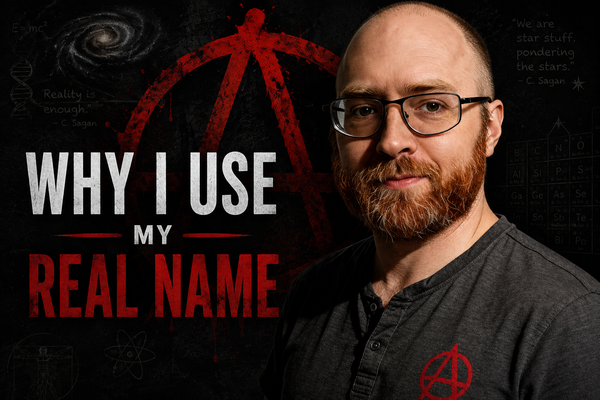
And reality was enough.