The Moment I Knew I No Longer Believed
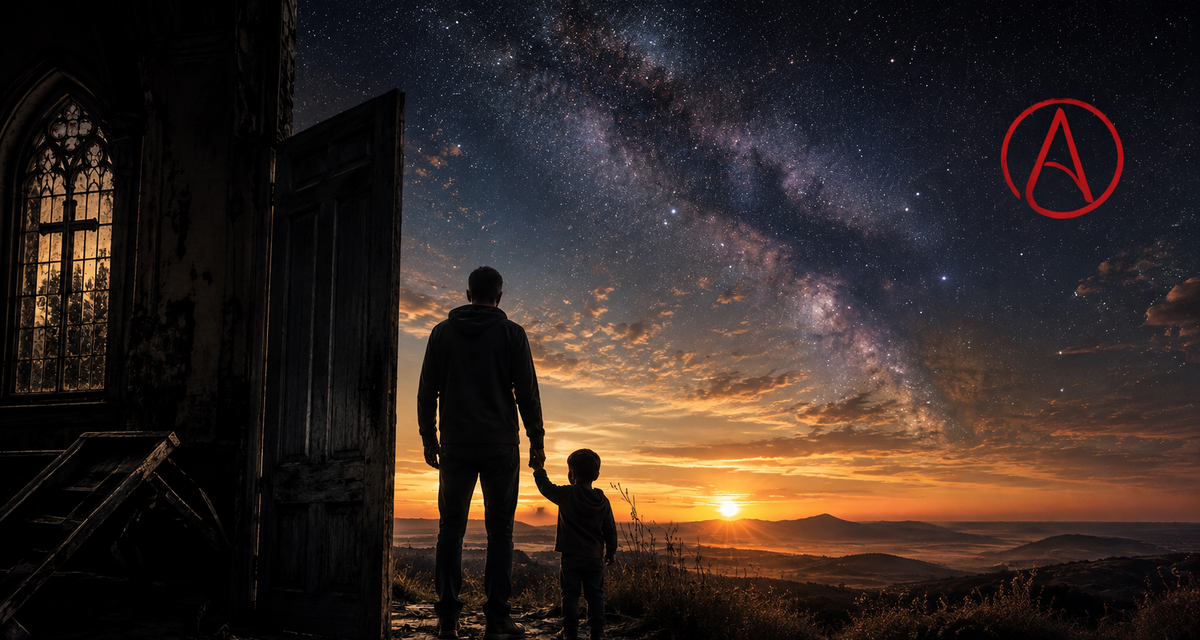
I was sixteen the first time I stopped believing in God. It didn’t stay that way — not for long— but that was the first time.
I told my parents. It went badly. Badly enough that I learned, very rapidly, what it costs to say the true thing out loud in an environment that isn’t ready to hear it. So I did what a lot of scared sixteen-year-olds do: I put the mask back on. I faked my way through evangelical Christianity for the rest of high school and straight through the front doors of college, nodding along at the right moments, praying out loud when it was expected, becoming fluent in a belief I’d already privately buried. When the arguments against evolution were spouted off at the podium, I kept my head down. When the abstinence pledges were taken, I didn’t go to the front but I didn’t openly mock them either. I just went home and fooled around with my girlfriend per the norm.
After that, I drifted. In and out, in and out — belief as regular as the tide rather than a true decision. Nothing stuck long enough to call it faith. It was more like static on a TV that won’t go away.
Then I had my first child, and the static resolved into something specific: Judaism. It wasn’t random. I wanted structure, lineage, a tradition my kids could stand inside of — something with more scaffolding than the vague nothingness I’d been drifting through. For a while, that scaffolding held. I converted, we celebrated, but nothing ever felt quite “right”.
Years later, in the middle of a genuine mental health struggle, I converted again — this time to the Kagyu school of Tibetan Buddhism. I wasn’t looking for doctrine. I was looking for a way to survive my own mind, and the practice gave me something to hold onto that wasn’t a pill or a diagnosis. It helped, for a while, in the way that anything that gives you a slight foothold helps, but the mystical aspects of Tibetan Buddhism still drove me crazy.
And then, some winding years after that, I became a Christian. Not quietly, either — I became a born-again Christian musician. I used AI and my own prowess from my high school youth-group band days and sang about a certainty I have to be honest and say, I never fully possessed. I built an identity and a community out of it. By every outward measure, I was the most devout I’d ever been. I got the tattoos. I wore the crosses and the T-shirts. I lived the walk.
The moment I knew — really knew, in the way that doesn’t let you go back to sleep — came while I was already standing inside that Christian identity, AI guitar in hand, songs written, community built. I took a look at the “me” I’d always wanted to be as a young man: someone honest, someone who followed what was true even when it cost him something. Someone who would rather, to paraphrase Milton, rule in hell than serve in Heaven. And I looked at the “me” I’d actually become: someone who had latched onto whatever belief system gave him the most stability at the time he needed it most…but who didn’t really believe any of it.
Reform Judaism when I needed structure for my new family. Tibetan Buddhism when I needed to survive my own head. Christianity when I needed belonging and a stage to stand on. Every single conversion, when I finally lined them up end to end, had the same engine underneath it. I wasn’t chasing truth. I was chasing whatever would hold me up during that particular year.
That’s when I understood: I was a Christian for comfort instead of reality.
The second time I told the people around me I didn’t believe, it wasn’t the reckless confession of a scared teenager. It was quieter, and heavier, because I’d built so much more to lose — a career, a community, an identity I’d worn long enough to be mistaken for my skin.
But the sixteen-year-old who told his parents the truth and got burned for it was still in there. He’d just been waiting, through Judaism and Buddhism and a stage full of worship songs, for me to stop needing a costume and start needing the truth instead.
Turns out I’d been an atheist the whole time. I just kept converting to other things so I wouldn’t have to sit in reality with it.